


Purposeful Lighting
Every light fixture should serve a clear purpose, such as illuminating entrances, pathways, or stairs. Unused or unnecessary lighting should be removed or switched off to reduce energy waste and light pollution.

Light The World Science & Technology Ltd. was established in 2008, dedicated to providing lighting products with low harm to the earth's environment. Today, it is more towards the goal of ESG sustainable development, and is truly moving towards a lighting business where environmental protection and economic development go hand in hand.
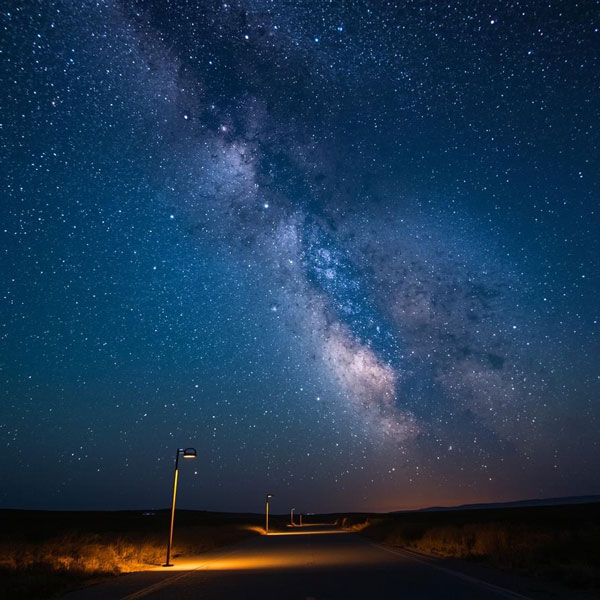
Good outdoor lighting should provide the right amount of light, in the right place, at the right time. By preventing unnecessary light from escaping into the sky or surrounding areas, our lighting solutions utilize optimized optics, color temperature selection, brightness control, and intelligent management systems to improve nighttime safety, reduce energy waste, and minimize impacts on humans and ecosystems.
These five principles provide important guidelines for residential, roadway, landscape, and public lighting design, improving lighting quality while reducing light pollution and energy consumption.
Every light fixture should serve a clear purpose, such as illuminating entrances, pathways, or stairs. Unused or unnecessary lighting should be removed or switched off to reduce energy waste and light pollution.
Lighting should be directed downward only where illumination is required. Proper shielding and optimized beam patterns prevent unwanted light from spreading into the sky, nearby properties, or surrounding areas.
Lighting with a warm color temperature below 3000K is recommended. For residential outdoor lighting, 2700K or lower can help reduce blue light impact while creating a comfortable nighttime environment.
Outdoor lighting should be connected with switches, timers, or motion sensors to operate only when needed. Smart control systems reduce unnecessary nighttime operation and improve energy efficiency.
Lighting should use the minimum brightness required for its application. Excessive illumination creates glare and may reduce visual comfort. Selecting the proper lumen output improves efficiency and visibility.
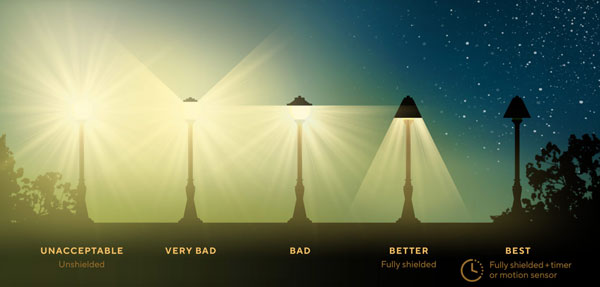
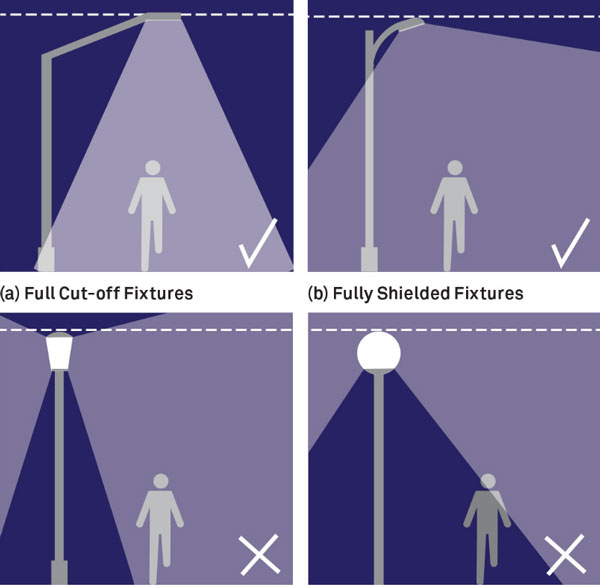
Effective outdoor lighting is not about maximum brightness, but about directing light precisely where it is needed. Through optimized brightness, warm color temperature, and controlled light distribution, lighting systems can improve pedestrian safety, reduce glare, and protect the nighttime environment.
By applying full cutoff fixtures, downward lighting, warm spectrum sources, and intelligent lighting controls, we can significantly reduce light pollution, lower energy consumption, and help people reconnect with the beauty of the night sky.